

Blepharoplasty in São Paulo, Brazil
Eyelid surgery with millimeter precision. The rested look no one can quite name.
Dr. Lucas F. M. Carneiro · Physician · Plastic Surgeon · CRM/SP: 136.298 · RQE: 50.532
- Isolated upper eyelid
- in my practice: local anesthesia alone, at the clinic, about 1.5 hours, same-day discharge
- Lower or combined
- in my practice: hospital, general anesthesia
- Suture removal
- 5 to 7 days
- Return to office
- 7 to 10 days
- Social presentability
- 10 to 14 days
- Follow-up visits
- 7, 14, and 21 days, and 2 months
- Final result
- 6 to 8 weeks for swelling; scar matures up to 12 months
In short
Blepharoplasty treats excess skin and fat pouches in the upper and lower eyelids. In my practice, isolated upper eyelid surgery is performed under local anesthesia alone, at the clinic, in about 1.5 hours, with same-day discharge. For the lower eyelid or four-eyelid surgery, I follow a more conservative protocol: I perform it in a hospital, under general anesthesia. Other recognized anesthesia strategies exist for blepharoplasty, but this is the approach I have chosen for my lower and combined cases. In the lower eyelid, the approach can be transconjunctival — through the inside of the eyelid, with no external scar — when the anatomy allows it. Follow-up visits at 7, 14, and 21 days, and 2 months. Return to office work usually occurs in 7 to 10 days, and social presentability between 10 and 14 days.
What happens
Why the eyes age
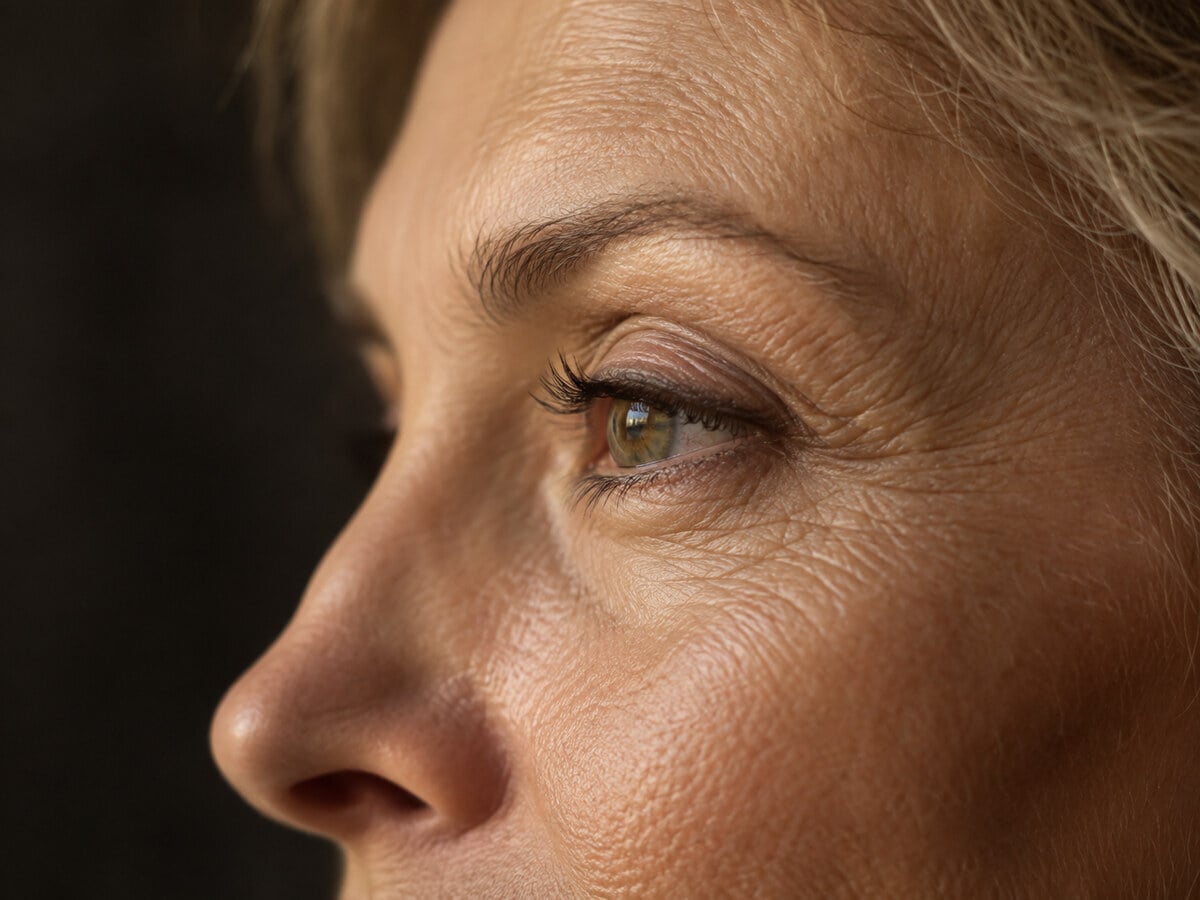
"Everyone asks if I'm tired. And I slept well." The eyelid is the thinnest skin on the body, and it is the first to show the passage of time. In the upper eyelid, excess skin — dermatochalasis — forms a fold that weighs on the lashes and, in more advanced cases, encroaches on the visual field. In the lower eyelid, the septum that holds the orbital fat weakens, and the fat protrudes as a pouch; at the same time, the cheek loses volume and forms the groove that separates the eyelid from the cheek.
Not every "dark circle" is surgical. A fat pouch, yes. A dark patch from hyperpigmentation, no — it has other causes and other treatments. Telling one from the other is part of the consultation.
Indication
Who it is for — and who I do not recommend it for
I recommend blepharoplasty for:
excess upper eyelid skin that weighs on the eyes or affects vision;
fat pouches in the lower eyelids that create a tired look;
redundant lower eyelid skin;
anyone who wants a more rested, expressive look, without appearing operated on;
generally from age 35 onward, when there is a pre-existing change or early aging of the area.
I do not recommend — or I postpone — when:
there is uncontrolled dry eye: surgery can make it worse;
there is active or unstable thyroid eye disease, or uncontrolled glaucoma; systemic thyroid disorders must also be adequately controlled before surgery;
the expectation is to eliminate expression lines or blemishes — that is not what blepharoplasty does;
the patient smokes and does not plan to stop during the pre- and postoperative period;
the eyelid droop is due to weakness of the levator muscle (true ptosis) rather than excess skin: in that case the surgery is different, and ptosis correction is indicated, alone or combined.
Consultation
How I assess you in consultation
In the upper eyelid, I measure the excess skin with the pinch test — gently pinching the redundant skin — and I check for a drooping eyebrow, because part of the "excess skin" may actually be a low eyebrow; in that case, removing too much skin makes the droop worse. I assess levator muscle function and the visual field.
In the lower eyelid, I assess three things: how much fat pouch there is, how much skin there is, and the eyelid's tone — the snap-back test shows whether the eyelid returns well to position. A loose eyelid that receives only skin resection is at risk of scleral show or ectropion; in those cases, I add a support procedure, such as a tarsal strip. I also assess the groove between the eyelid and cheek, which may call for fat repositioning rather than removal.
The examination determines the approach: about 20% of my lower blepharoplasties are transconjunctival — patients with pouches and little redundant skin, in whom I remove or reposition the fat from the inside, with no external scar.
In selected cases, I request an ophthalmologic evaluation before surgery.
Technique
The techniques
| Technique | Upper | Lower transcutaneous | Lower transconjunctival |
|---|---|---|---|
| Treats | excess skin and, when necessary, fat | skin, muscle, and pouches; may include fat repositioning | fat pouches; may include repositioning in selected cases |
| Incision | in the eyelid's natural crease | just below the lashes | inside the eyelid, with no external scar |
| Anesthesia in my practice | local anesthesia alone, at the clinic, if isolated | general, in a hospital | general, in a hospital |
| Typical indication | dermatochalasis | redundant skin + pouches | pouches with good-quality skin (about 20% of my cases) |
| Support procedures | — | tarsal strip / canthopexy when the eyelid is loose | fat repositioning when there is a groove, depending on anatomy |
Step by step
How the surgery is done

Isolated upper eyelid. At the clinic, under local anesthesia alone, in about 1.5 hours. I mark the incision in the natural crease, remove the strip of skin measured with the pinch test and, when necessary, a small amount of medial fat. Closure is with fine sutures, removed in 5 to 7 days. Same-day discharge, with 3 to 5 days of rest.
Lower eyelid or four eyelids. In my practice, exclusively in a hospital, under general anesthesia. Blepharoplasty can be performed with different anesthesia strategies; this is the choice in my protocol for lower and combined cases. In the transcutaneous approach, the incision sits just below the lashes; I treat the pouches, reposition fat when there is a groove, and remove only the excess skin left after repositioning — never before, because what looks like excess while lying down changes once the patient sits up. When the eyelid is loose, I add a tarsal strip. In the transconjunctival approach, the access is from the inside and there is no external scar.
The amount of skin removed is the single most important decision in blepharoplasty. Removing too much from the upper eyelid leaves an eye that will not close; from the lower eyelid, scleral show. Removing too little leaves the complaint unresolved. The precision is measured in millimeters, and that is where the difference between technique and experience lies.

Who operates
Dr. Lucas F. M. Carneiro
Plastic Surgeon · CRM-SP 136.298 · RQE 50.532
- Board-certified plastic surgeon — Specialist Title by the Brazilian Society of Plastic Surgery (SBCP), recognized by the AMB and the Ministry of Education
- Medical staff of Hospital Israelita Albert Einstein since 2015
- Residency in Plastic Surgery — Faculdade de Medicina do ABC
- Fellowship — DKFZ, German Cancer Research Center, Heidelberg
- Creator of the Método Plástica para Pacientes (Plastic Surgery for Patients Method)
- Consults in English, Portuguese and Spanish
- Featured in Band (Brazil) on the safety of combined plastic surgery
Transparency
Risks — and how I manage each one
Bruising (ecchymosis) and swelling — expected; cold compresses for 15 minutes every 2 hours during the first 4 to 6 hours reduce both.
Hematoma — rare; an orbital/retrobulbar hematoma is a potentially vision-threatening emergency. Severe pain or eye pressure associated with a change in vision requires immediate evaluation and emergency treatment. In my practice, this is one of the reasons I perform lower blepharoplasty in a hospital setting, with monitoring and the capacity for an immediate response.
Transient dry eye — common in the first weeks; lubricant every 2 hours, avoiding contact lenses, and wearing corrective glasses during this period.
Scleral show and ectropion — the risk is reduced through preoperative assessment of eyelid tone, conservative skin resection, and support procedures such as canthopexy or tarsal strip when indicated.
Difficulty closing the eye (lagophthalmos) — almost always transient, due to swelling; prevention is conservative skin resection.
Asymmetry — small asymmetries are part of normal anatomy; significant asymmetries may be revised after full healing.
Visible scar — rare in the upper eyelid, because it sits in the crease; in the lower eyelid, the subciliary incision matures into a fine line.
Recovery
Recovery
| Period | What to expect | What to do |
|---|---|---|
| First 4 to 6 hours | swelling begins | in my protocol, intermittent cold compresses |
| Days 1 to 3 | swelling and bruising peak | head elevated; prescribed lubrication; no exertion |
| Days 5 to 7 | suture removal; first follow-up at 7 days | local care |
| Days 7 to 10 | most patients return to office work | gradual resumption of activities |
| Days 10 to 14 | social presentability; second follow-up at 14 days | makeup over intact skin |
| Weeks 2 to 3 | time off recommended for those with public exposure; third follow-up at 21 days | gradual return |
| 30 days | sun exposure and exertion gradually allowed | sun protection |
| 6 to 8 weeks | residual swelling usually much reduced; 2-month follow-up | reassessment |
| up to 12 months | scar maturation | sun protection and follow-up |


Where I operate
In my practice, isolated upper eyelid blepharoplasty is performed at the clinic, under local anesthesia alone, in an environment appropriate for the procedure. Lower and four-eyelid surgery is performed in a hospital, under general anesthesia, in the vast majority of cases at Hospital Albert Einstein, where I have been on the medical staff since 2015. Other recognized settings and anesthesia strategies exist; this distinction is part of my safety protocol. Hospital Albert Einstein
Patients from other cities and countries
The evaluation consultation can be done by video, with standardized photographs. For lower or combined blepharoplasty, your stay in São Paulo covers the follow-up visits at 7 and 14 days; the remaining ones can be done by video. international patients
Método Plástica para Pacientes (Plastic Surgery for Patients Method)
Pre- and postoperative care follows the structure of the Método Plástica para Pacientes (Plastic Surgery for Patients Method), which I created to organize the consultation, preparation, and follow-up through to the final result. the Method
Frequently Asked Questions
Questions about Blepharoplasty
Does blepharoplasty change your eyes?
It doesn't change them — it restores them. The goal is for you to look rested and expressive, not like someone else. The amount of skin removed is decided to the millimeter for exactly this reason.
What is the difference between upper and lower blepharoplasty?
The upper procedure treats the excess skin that weighs on the eye; the lower one treats the fat pouches and redundant skin beneath it. They can be done separately or together, and the anesthesia and setting differ: isolated upper eyelid surgery at the clinic under local anesthesia; lower or four-eyelid surgery in a hospital, under general anesthesia.
What is transconjunctival blepharoplasty?
It is access to the lower eyelid from the inside, through the conjunctiva, with no skin scar. I recommend it when the main complaint is the pouches and the skin is of good quality — about 20% of my lower eyelid cases.
Does blepharoplasty eliminate dark circles?
It eliminates the fat pouch. It does not eliminate the dark patch from hyperpigmentation, which has other causes and other treatments. The consultation distinguishes between the two.
What is recovery like?
Cold compresses in the first hours, swelling and bruising for 2 to 3 days, sutures removed in 5 to 7 days. Return to office work in 7 to 10 days, social presentability between 10 and 14 days, and time off until the second or third week for those with public exposure.
Can I wear contact lenses afterward?
Avoid them in the first weeks. Use corrective glasses and lubricant every 2 hours; I clear contact lenses at the follow-up visit, once the eyelid is comfortable.
Why is the lower eyelid only operated on in a hospital?
Because an orbital/retrobulbar hematoma, although rare, requires immediate recognition and response. In my practice, I prefer to perform lower eyelid surgery in a hospital and under general anesthesia to have monitoring, anesthesia control, and response infrastructure available. This is a choice within my protocol; other anesthesia strategies are recognized in the literature.
Does health insurance cover it?
When there is documented visual field impairment confirmed by an ophthalmologic evaluation, upper blepharoplasty may be classified as reconstructive, and coverage depends on the plan and the documentation. My team guides you through the process.
How long does the result last?
The tissue removed or repositioned does not simply "revert" to its previous state, but aging continues. Over the years, new skin laxity, volume changes, and new pouch projection can occur. In my practice, I explain that many results remain satisfactory for several years, often in the range of 6 to 10 years, but this is a clinical expectation and not a guarantee; genetics, sun protection, skin quality, and lifestyle all influence how it evolves.
Can blepharoplasty be combined with a facelift?
Yes, and it's a common combination — a facelift does not treat the eyelids. In that case, everything is done in a hospital, under general anesthesia, with the surgical plan kept within a safe operating time.
Glossary
- Dermatochalasis
- excess eyelid skin from aging.
- Pinch test
- pinching the skin to measure the excess to be removed.
- Transconjunctival
- access through the inner surface of the eyelid, with no skin scar.
- Scleral show
- exposure of the sclera below the iris due to a low lower eyelid.
- Ectropion
- outward turning of the lower eyelid.
- Tarsal strip / tarsoplasty
- shortening and fixation of the tarsus to the periosteum to support the eyelid.
- Lagophthalmos
- incomplete closure of the eye.
Medical and regulatory references
- American Society of Plastic Surgeons. Practice Parameter for Blepharoplasty. Anesthesia: local, local with intravenous sedation, or general anesthesia according to patient and procedure.
- Gimenez AR, Rohrich R, Borab Z, Fisher S, Fagien S, Rohrich RJ. Safety and Complications in Lower Eyelid Blepharoplasty: A Systematic Review. Plast Reconstr Surg Glob Open. 2025;13(9):e7102. doi:10.1097/GOX.0000000000007102.
- Memon SF, Wilde CL, Ezra DG. Lower Eyelid Surgical Anatomy and the Implications for Blepharoplasty Surgery: A Systematic Review of Anatomic Studies in the Literature. J Craniofac Surg. 2025;36(2):709-716. doi:10.1097/SCS.0000000000010928.
- Hass AN, Penne RB, Stefanyszyn MA, Flanagan JC. Incidence of postblepharoplasty orbital hemorrhage and associated visual loss. Ophthalmic Plast Reconstr Surg. 2004;20(6):426-432. doi:10.1097/01.IOP.0000143711.48389.C5.
- Visual loss after blepharoplasty: incidence, management, and preventive measures. Aesthet Surg J. 2011. PubMed PMID: 21239669.
- Transconjunctival or Transcutaneous Approach for Fat-preserving Lower Lid Blepharoplasty? Systematic review. PubMed PMID: 41415593. 2025.
- Conselho Federal de Medicina (Brazilian Federal Council of Medicine). Resolution CFM 2.336/2023 — medical advertising rules.
Educational content, written and clinically reviewed by Dr. Lucas F. M. Carneiro · Physician · Plastic Surgeon · CRM/SP: 136.298 · RQE: 50.532. It does not replace a medical consultation.
Next Step
Book your consultation with Dr. Lucas
Every case is assessed individually. The first step is a conversation — online or in São Paulo.